
The Issue: We have known about “The Word Gap,” for 20 years. Risley and Hart[1], in their ominously titled study, “The Early Catastrophe,” found that children from disadvantaged backgrounds hear, on average, 30m fewer spoken words by the age of 3 than their more advantaged peers. Unsurprisingly, that is mirrored in the way children speak and interact in school, with a vast disparity between the number of new words children use, their confidence in speaking and their willingness to listen.
Also unsurprising is the fact that the disparity in vocabulary acquisition increases in impact as children get older and is closely related to the disparity in the academic outcomes achieved by children from less advantaged backgrounds. The only thing that is surprising is that western education policy, which has fixated on closing the attainment gap for every one of those 20 years, appears not to have noticed any of this!
Language and understanding are intrinsically linked. Words and their meanings underpin thinking and reasoning and better language skills lead to a stronger working memory and faster “processing speed.” Put simply, talking helps us to make sense of the world and to participate in it.
A child who is not at the expected standard of language development at the age of 5 is eleven times less likely to achieve the expected standard in maths at the age of 11. Of 1,300 teachers surveyed by The Oxford University Press in 2018, 77% said that students without sufficient vocabulary have difficulty following what is going on in class and 85% said that they make slower than expected progress.
All of this is important, we want all our children to do well in school, regardless of their starting point or socio-economic background. But the importance of talking doesn’t stop there. Its speaking that allows us to make friends, to express how we feel, to ask the right questions, to influence the behaviour of others, to share ideas and understand new things.
Navigating childhood with all its cruelties and joys, without the language skills to be in on the joke and part of the game is a chilling prospect! We also know what this looks like as children get older and their lack of the words to express a view or answer a question impacts on their self-esteem, motivation and behaviour and, consequently, on our opinion of them – we call it “Special Needs.”
The graphic below is taken directly from Andrea Quincey’s contribution to the Oxford University Press Language Report, “Why Closing the Word Gap Matters.”[2] it captures, both accurately and emotively, the link between oracy, wellbeing and our own word-wealthy perception of ability.
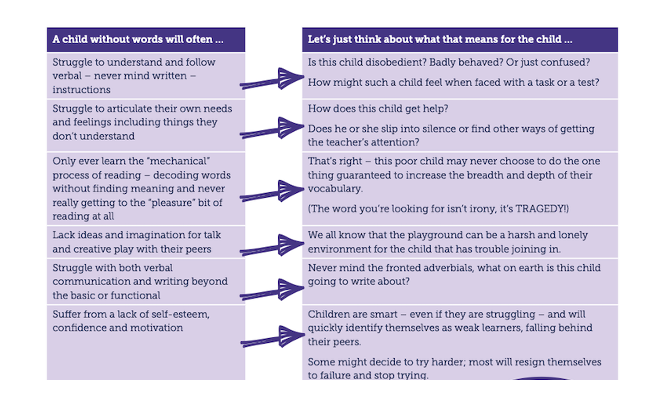
The irony
According to the OUP, 67% of primary teachers and 80% of secondary teachers identify improving oracy as a priority in their school. That being the case, it’s reasonable to assume that most schools will have a well-thought-out strategy for improving oracy amongst their students and a school-wide focus on developing confident, collaborative speakers. Sadly, that is not the case.
According to that same survey, only a minority of schools have specific programmes to identify and support students with a limited vocabulary, let alone any sort of overt mission to grow articulate, reflective and intellectually confident young people. So, whilst we bemoan student attitudes, disinterest in what we’re trying to teach them or unwillingness to answer a question or express a view, we might reflect on the opportunities we still have to change this.
Also ironic is that GCSE English, where we might expect to find a deep understanding of this area, expects students to “acquire and apply a wide vocabulary, alongside a knowledge and understanding of grammatical terminology, and linguistic conventions for reading, writing and spoken language,” but, in 2013, speaking and listening was removed from the qualification.
Students still need to have a speaking and listening assessment grade but, since this, “will not form part of the final mark and grade,” English teachers tend to focus on the heavy weight of texts to be read and feel there is insufficient time for doing the very thing which would improve their students’ understanding and engagement with these texts as well as preparing them for successful adulthood. Allowing examination assessment criteria to dictate how we teach our subject to our students appears reductionist at best.
The final irony is that these word-poor students are unlikely to choose to do the thing which would not only improve their vocabulary and written English, but would also open a world of possibility and imagination – read for pleasure! To access these benefits, texts need to be of sufficient quality to challenge and engage the reader and make them want more. Those with limited opportunities to start this at home, hampered by poor oracy and low self-esteem and then offered simplistic texts suitable for their “ability” at school, are highly unlikely ever to get to the point when reading is anything but a chore and an embarrassment!
What can we do?
Teachers have a vital role to play, all all levels. There is no substitute for high expectations and teachers have a responsibility to create a language-rich classroom with frequent and varied opportunities for productive talk. We must model what we expect from students through how we use academic language and appropriate vocabulary and through what we value in our classrooms. Silence has a time and place but it is no longer regarded as the mark of productive learning.
We need to plan into our teaching, deliberate opportunities for students to engage in back-and-forth conversation, to make and defend a point of view and to ask the questions as well as answering them. It isn’t enough to tell those with limited vocabulary and little experience of the rules of discussion to, “discuss in groups and come back with some ideas.” Helping students to recognise and grow the range or oracy skills they need to enjoy their learning and be successful, requires active planning and frequent opportunities for practise and this should be a priority in all phases and in all subject areas.
Using words in context and expecting children to respond by applying new terminology correctly, is the foundation of vocabulary acquisition. Whether this is multiplication or metathinking, it’s important that even the youngest children have access to the right words for what they are doing, learning or thinking. Having an oracy policy for the whole school which embeds these sorts of expectations, is a place to start.
[1] https://www.aft.org/sites/default/files/media/2014/TheEarlyCatastrophe.pdf
very good article
i think the article powerfully articulates a long-standing and urgent issue in education — the “Word Gap” — and connects it convincingly to student outcomes, wellbeing, and equity.
Thank you, Huma, it seems to me that teaching children to be critical listeners and confident speakers is the most important thing schools do…. for health and happiness as well as success!
This really speaks to our context in the UAE. So many of our students are bilingual, but they still need far more structured opportunities to talk, rehearse new vocabulary and hear good academic English modelled. EAL learners won’t just absorb this naturally. If we want confident, capable thinkers, we have to treat oracy as core learning, not an add-on. In a diverse school like ours, strong classroom talk isn’t optional—it’s the foundation that makes everything else work.